To delete a WordPress theme, go to Appearance > Themes, click the theme you want to remove, then click Delete in the bottom-right corner of Theme Details and confirm. WordPress won’t let you delete your active theme or the parent of an active child theme, so switch themes first if you need to.
Removing themes you don’t use is worth the minute it takes. WordPress’s own Site Health screen recommends it “to enhance your site’s security,” because an inactive theme’s code still sits on your server and still needs updates. It also recommends keeping three themes: a default theme, your active theme and that theme’s parent.
- Delete themes from Appearance > Themes > Theme Details > Delete. The button doesn’t appear for the active theme.
- WordPress blocks deleting the parent of your active child theme with “You cannot delete a theme while it has an active child theme.”
- Keep one default theme, such as Twenty Twenty-Five. If your active theme breaks, WordPress falls back to it.
wp theme delete --allin WP-CLI removes every theme except the active theme and its parent.- Deleting a theme removes its files but leaves its Customizer settings in the database, so reinstalling the same theme brings them back.
Before you delete a theme
- Check which theme is active. WordPress hides the Delete link for it, and deleting it over FTP takes your site’s design down with it.
- Check for a child theme. If your active theme is a child theme, its parent has to stay installed.
- Keep one default WordPress theme. When the active theme is broken, WordPress switches to the default theme if one is installed.
- If you edited the theme’s files directly, take a backup first. Deleting a theme can’t be undone, and those edits go with it.
- On a multisite network, themes are deleted from Network Admin > Themes. Individual sites don’t get a Delete link.
Method 1: Delete a theme from the WordPress dashboard
- In your WordPress admin, go to Appearance > Themes.
- Hover over the theme you want to remove and click Theme Details. Each card shows the theme’s screenshot.png, so a blank card usually means a theme (often a child theme) with no screenshot file.
- Click Delete in the bottom-right corner of the Theme Details window.
- Confirm the prompt, “Are you sure you want to delete this theme?”
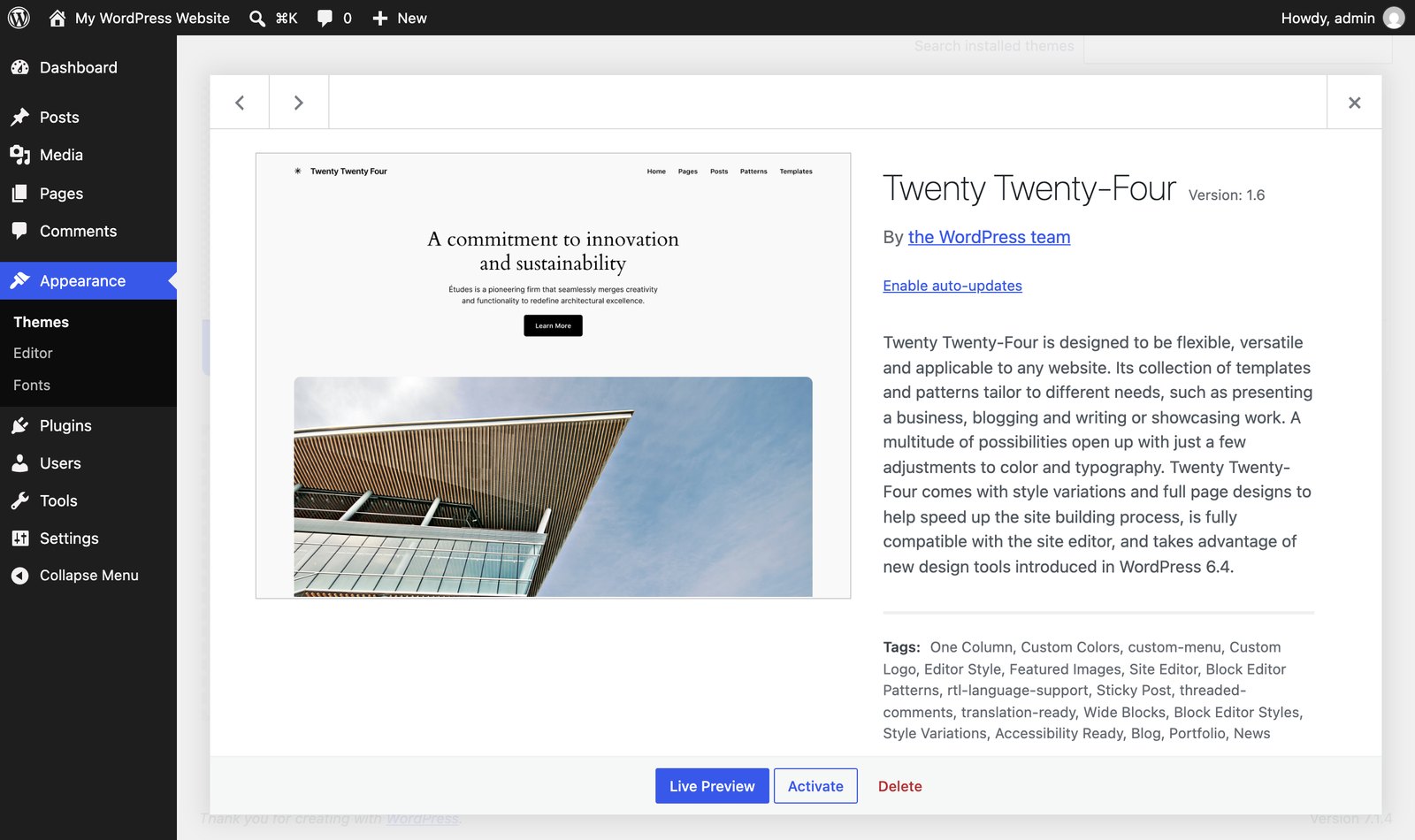
Repeat for each theme you want to remove. If there is no Delete link, the theme is active, you are on a multisite site, or your user account doesn’t have permission to delete themes (by default only administrators do).
Prefer video? This walkthrough was recorded on an older version of WordPress, but the steps are the same:
Method 2: Delete themes with WP-CLI
With WP-CLI, list your themes, then delete by slug:
wp theme list

wp theme delete twentytwentythree
To clear out everything you are not using, wp theme delete --all deletes every theme except the active one. WP-CLI’s code also skips the parent of the active theme. Both are only deleted if you add --force, so leave that flag off. Note that --all also removes the default themes, so reinstall one afterward if you want a fallback:
wp theme delete --all
wp theme install twentytwentyfive
Method 3: Delete a theme with FTP or your host’s file manager
If you can’t get into the dashboard, connect with FTP, SFTP or your host’s file manager and open wp-content/themes. Each theme is a folder named after its slug. Delete the folder for the theme you want to remove.

This skips WordPress’s safety checks, so double-check the folder name. If you delete the active theme’s folder, your site breaks until an administrator opens Appearance > Themes, where WordPress shows “The active theme is broken. Reverting to the default theme.” and switches to a default theme, if one is installed.
What deleting a theme leaves behind
WordPress’s delete_theme() removes the theme’s folder and its translation files. It doesn’t remove the theme’s Customizer settings, which live in the database as an option called theme_mods_ plus the theme’s slug. SmartWP’s own database still has a theme_mods_twentynineteen row long after Twenty Nineteen was deleted.
That is mostly harmless, and it is why reinstalling a theme brings its old settings back. If you are sure you won’t use the theme again, you can remove the row with WP-CLI:
wp option list --search="theme_mods_*" --fields=option_name

wp option delete theme_mods_twentynineteen
Frequently asked questions
Why can’t I delete my WordPress theme?
There are four usual reasons. It is your active theme, it is the parent of your active child theme, you are on a multisite site (themes are deleted from Network Admin), or your account lacks the delete_themes capability, which only administrators have by default. Activate a different theme first if it is the active one.
Will deleting a theme delete my posts and pages?
No. Posts, pages, media, menus and widgets are stored in the database, not in the theme. Deleting a theme removes only its files, so anything stored in the theme itself, such as custom template files or code you added to its functions.php, goes with it.
Should I delete the default Twenty Twenty themes?
Delete the ones you don’t need, but keep one. Site Health recommends keeping a default theme, and WordPress falls back to it if your active theme breaks.
Can I undo deleting a theme?
Not directly, but you can reinstall it from Appearance > Themes > Add Theme, or upload its ZIP again. Because WordPress keeps the theme’s Customizer settings in the database, they come back when you reinstall the same theme. Changes you made to the theme’s files are lost unless you have a backup.
Is it safe to delete inactive themes?
Yes, as long as you keep your active theme, its parent theme and one default theme. WordPress’s Site Health recommends removing the rest to enhance your site’s security.